
Explore Our Blog
Practical guides for Sydney builders, flooring contractors and facilities teams planning concrete grinding, adhesive removal and floor preparation.
Peeling Epoxy Floors: Removal and Recoating Preparation for Sydney Businesses
What Sydney commercial clients need checked before retaining or removing old epoxy, with preparation-only scope and a documented slab-handover example.
A peeling epoxy floor should be assessed before another coating is applied. Loose material needs removal, and the extent of preparation depends on the condition of the remaining coating and the concrete beneath it. Any coating proposed to stay must be accepted under the replacement system’s preparation and compatibility requirements.
For a Sydney warehouse, workshop or commercial tenancy, the useful question is: what can remain, what must be removed, and what needs checking before the new flooring starts? An apparently intact surface alone is not enough to answer that. Dulux Avista’s repair and compatibility guidance illustrates why both the bond and the proposed coating system matter.
Surface wear and peeling need different checks
A worn finish and a coating separating from its base can require different scopes. The inspection needs to establish whether the problem is confined to a finish layer, occurs between coatings, or involves the bond to the concrete. Appearance alone does not establish the cause or the removal boundary.
Concrete condition, oil or other contamination, moisture and the previous preparation also need consideration. Sika’s Australian Sikafloor-264 instructions require assessment of substrate soundness, cleanliness and moisture conditions before installation. These are checks for the selected system, not a diagnosis of every peeling floor. Sikafloor-264 product data sheet
What should be checked before choosing a recoat?
| What you can see | What needs checking | Possible implication for preparation |
|---|---|---|
| A dull or worn finish with no obvious lifting | Existing product, adhesion and compatibility with the proposed system | A prepared recoat may be considered if the system supplier accepts the retained coating. |
| Flaking, lifting or separation around damaged areas | Extent of the loss of bond, including adjacent coating and interfaces between layers | Agree removal boundaries from the assessment rather than simply covering the visible patch. |
| Oil staining or a history of spills | Type and extent of contamination and the specified treatment | Cleaning, further removal or reassessment may be needed before installation. |
| Blisters, damp patches or previous moisture problems | Moisture testing and the replacement system’s requirements | Investigate the moisture condition before agreeing the next coating system. |
| Soft concrete, cracks or old patches exposed during removal | Substrate soundness and the repair or joint-treatment requirements | Agree additional preparation or repairs before the installer proceeds. |
These observations guide the inspection; they do not determine the failure cause. Fosroc’s Nitoflor FC150 HP instructions, for example, require a sound, clean, dry substrate and preparation that addresses loose material, old coatings and contaminants. The specified requirements for the actual replacement system govern the job. Fosroc Nitoflor FC150 HP technical data sheet
Agree what can remain before removal starts
Provide any available coating records, repair history and details of chemicals used on the floor. Identify the replacement flooring system early so its supplier or installer can confirm the preparation requirements and any testing needed.
Do not assume that an old coating is suitable to keep because it looks firmly attached. Compatibility is product-specific: Dulux Avista expressly advises against applying its water-based epoxy over its two-pack urethane. That example is not a rule for all products, but it shows why the coating history matters.
The written scope should record which areas will be removed, any areas proposed to remain, and what happens if removal reveals conditions outside the assessed scope.
Use a trial area to clarify the preparation method
A representative trial area can help establish how the existing coating responds to the proposed removal method. It can also expose a small part of the substrate before the wider scope is settled. Sika’s method statement identifies trial areas as one way to inform preparation-method selection. Sika surface evaluation and preparation method statement
Record the location, observed coating behaviour, exposed concrete condition and proposed next step. Treat the trial as information about that area, rather than a promise that the entire floor will behave identically.
Adhesion testing and moisture assessment are separate decisions. A successful removal trial does not replace the checks required by the incoming system’s supplier or installer.
Keep removal and replacement responsibilities clear
Resin Me Epoxy provides commercial epoxy and coating removal in Sydney, including preparation-only packages where another contractor installs the new floor. Filip Plesko reviews the scope directly before equipment selection and mobilisation.
A preparation package should distinguish:
- Coating removal: the identified materials, work areas and agreed removal boundaries.
- Follow-up preparation: the substrate condition required for the specified next system.
- Repairs and joints: treatment included in the scope, with newly exposed defects reviewed separately.
- Cleaning and inspection: industrial vacuum cleaning and review of the prepared area.
- Testing and installation: who arranges the required checks, accepts the substrate and installs the replacement system.
This lets builders and flooring contractors coordinate the preparation work with their chosen installer. Coating removal does not itself confirm that all installation requirements have been met. See our preparation-only floor packages.
A documented example of preparation-only handover
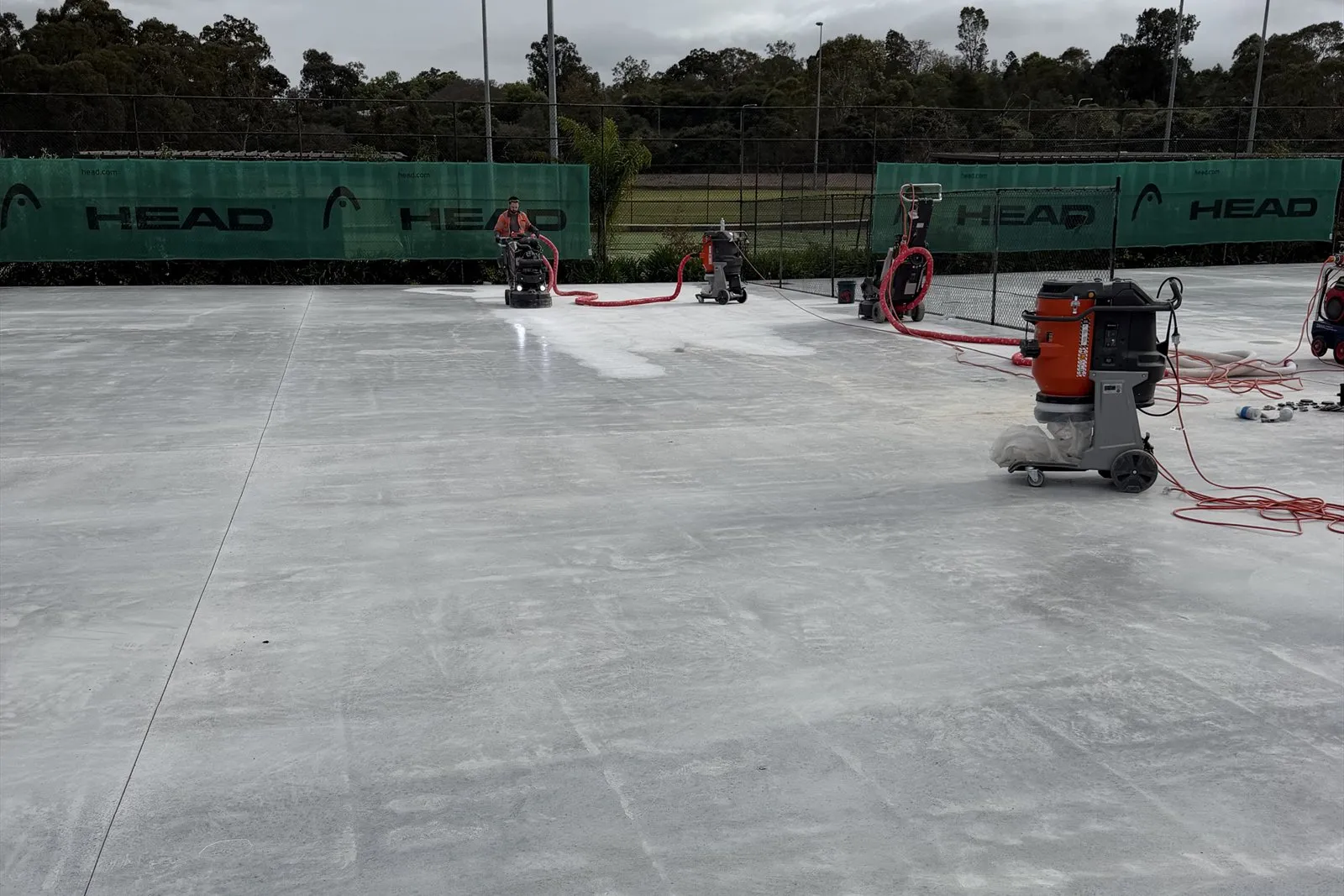
At the Parramatta tennis-court extension, Resin Me Epoxy removed concrete sealer and mechanically prepared 1,350 m² for a builder. Our scope ended at the prepared slab, which was handed over for the next surfacing stage.
This was a sealer-removal project, not a documented peeling-epoxy failure. It illustrates a useful way to organise the work: define the removal and preparation package, then make the handover to the next trade clear.
Plan access and staging around the business
Before mobilisation, confirm which areas can be cleared, how machinery will reach the slab, available power, edge access and any lift or loading restrictions. Include working hours, neighbouring operations, work-zone separation and waste-handling arrangements.
Dust-controlled removal and preparation need to be coordinated with the site’s operating restrictions. If work is staged, agree how each area will be released, inspected and protected before the next trade starts.
The removal programme and the new flooring system’s installation and return-to-service requirements need to be coordinated separately. Availability and timing are confirmed for each project.
Questions from commercial clients
Does peeling mean the entire floor must be stripped?
It does not establish the removal boundary by itself. The decision depends on the extent of poor adhesion, substrate condition and the replacement system’s requirements. Some systems require old coatings to be removed even where they appear intact.
Can grinding fix the reason the coating failed?
Grinding may form part of the preparation scope. It does not, by itself, establish that moisture, contamination or weak substrate has been resolved. Relevant findings need assessment before the next system is installed.
Can you prepare the floor for our existing flooring contractor?
Yes. Resin Me Epoxy assesses preparation-only work for builders, flooring contractors and commercial clients across Greater Sydney and surrounding areas. Send the installer’s specification so removal, preparation and handover can be agreed together.
Send Filip your floor details
For a coating-removal assessment, send:
- Site suburb and approximate floor area in m².
- Close-up and wider photographs of the coating.
- Coating history, repairs and known spills or moisture issues.
- Intended next flooring system and installer’s specification, if available.
- Required timing, access, power and operating restrictions.
Request a commercial coating-removal assessment, email admin@resinmeepoxy.com.au, or call Filip on 0490 101 266. Project availability is confirmed individually.
Resin Me Epoxy is operated by FJP Co Pty Ltd, ABN 63 670 338 682.